
In short
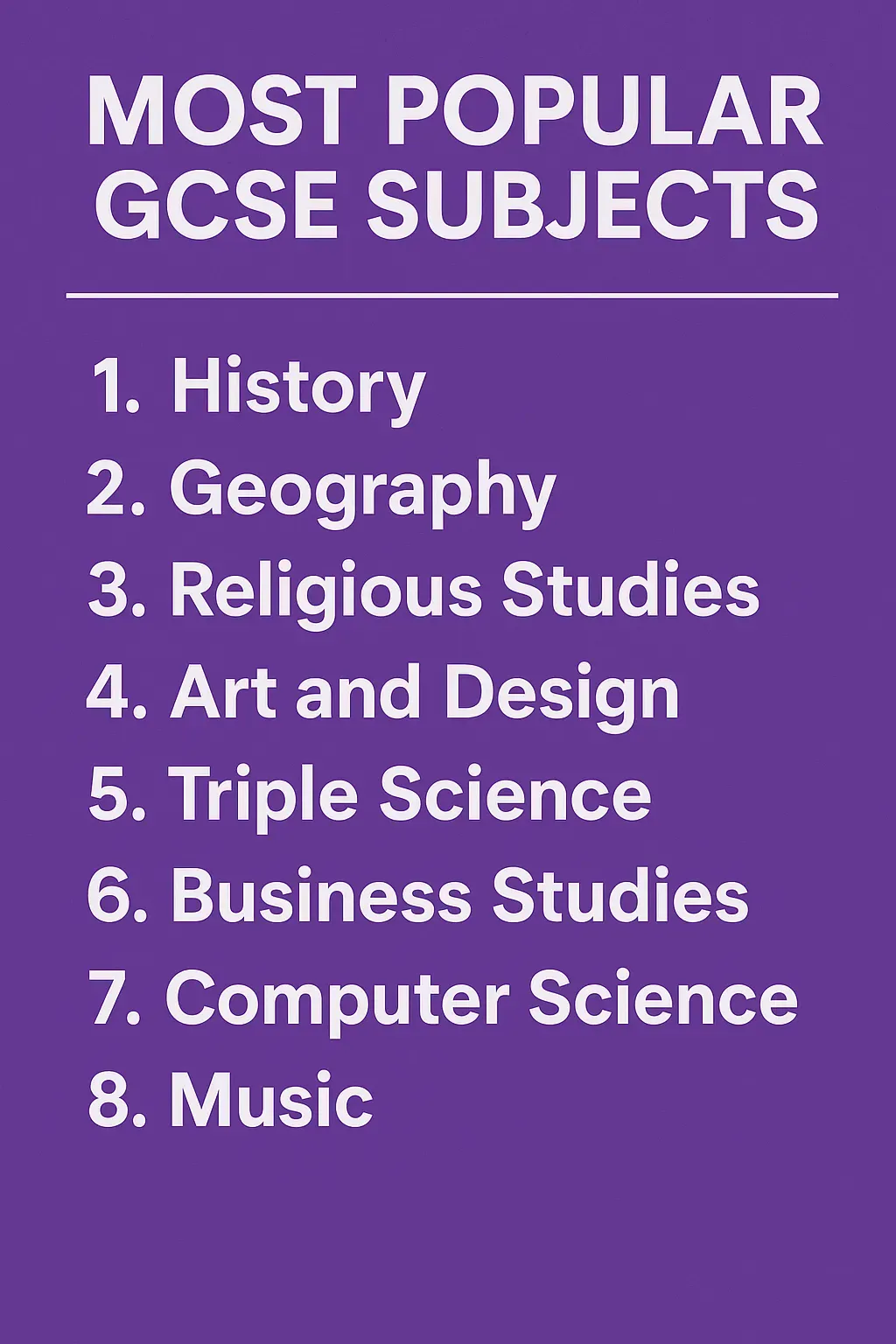
Beyond the compulsory core of English Language, maths and science, the most popular GCSE options in 2024 were History (325,437 students), Geography (297,411), Religious Studies (245,019) and Art and Design (208,934), followed by triple science, Business Studies, Computer Science and Music. Students should still choose subjects based on their strengths, interests and ambitions.
Key takeaways
- English Language, maths and science are compulsory, so they always have the highest GCSE entries.
- Most students take 8 to 10 GCSEs, with 4 or 5 chosen beyond the core subjects.
- History was the most popular optional GCSE in 2024, taken by 325,437 students.
- Triple science gives a separate 9–1 grade in biology, chemistry and physics.
- Choose GCSEs for your strengths, passions and ambitions, not because a subject seems popular or easy.
Every year, over 5 million GCSE results are released, which means a huge number of exam papers need marking. And while the core structure of GCSEs remains mostly the same, the subjects students choose can change slightly over time.
To understand popular subjects, it’s important to first get a clear picture of how the GCSE system works. Most students take between 8 and 10 subjects, though some choose to study even more than that.
There are three compulsory subjects everyone must take: English Language, Mathematics and Science in some form. Science can be combined as a double award or split into biology, chemistry and physics, depending on the school.
The three core subjects always have the highest entries because every student has to study them. As such, the real variation comes from the 4 to 5 additional subjects chosen beyond these basics.
Interestingly, Department for Education figures show steady patterns with some subtle shifts between years.
Here at Performance Learning, we’ve put together a guide on why these subjects are so popular for the students of today, and what you may want to know before picking one…
8. Music
The 8th most popular GCSE subject is music, which actually saw a 9% uptake in students last year, according to OCR.
It covers topics such as the elements of music, music appreciation, classical orchestral pieces, dance music, contemporary styles and world music, depending on the school.
Many enjoy expressing creativity and developing both technical and artistic skills through music, which is graded through a mix of coursework, practical exams and written exams, depending on the board.
7. Computer Science
With digital skills more in demand than ever, Computer Science continues to grow in popularity as a GCSE subject.
It introduces programming, algorithms and data structures, offering a solid starting point for tech-savvy students.
Pupils can expect to hone their skills thinking creatively, innovatively, analytically, logically and critically, while also building understanding of the impacts of digital technology to society.
6. Business Studies
With entrepreneurship, marketing and financial literacy becoming more relevant to teens, many students are drawn to Business Studies as a GCSE.
This subject provides pupils with a strong understanding of the business world, such as concepts, terminology, objectives and the impact of business on society.
Those who excel tend to stay on top of current events, because real-world business examples strengthen exam answers and make essays more relatable.
5. Biology, Physics and Chemistry (Separate Sciences)
Though all students must take science in some form at GCSE, some opt for what’s known as triple science.
This where you take biology, chemistry and physics as separate subjects. It is particularly popular among students eyeing careers in medicine, veterinary science or engineering.
Triple science provides a broader and deeper understanding of scientific concepts, and thus results in a separate 9-1 GCSE grade for each one.
4. Art and Design
Every year, art and design is a top choice for students looking to express their creativity through their GCSEs. In fact, a whopping 208,934 students chose it in 2024.
Sure, it’s coursework-heavy, but it’s also very rewarding for visual learners and those considering creative careers.
One of the main aims of art and design GCSE is to become confident in taking risks and learn from experience when exploring and experimenting with ideas, processes, media, materials and techniques.
3. Religious Studies
Religious studies often surprises people by how popular it is, with 245,019 students taking it as a GCSE in 2024.
It’s not just about learning world religions but about exploring ethics, philosophy and the moral issues we face today: from war and peace to human rights and medical ethics.
The subject challenges students to think critically about human rights, justice and morality from religious and non-religious perspectives alike. It’s ideal for those interested in philosophy, sociology or law, and includes belief systems like atheism, agnosticism and humanism.
2. Geography
Geography consistently reigns supreme as one of the most popular GCSE subjects (297,411 students took it in 2024) thanks to its broad scope.
The content covers everything from climate change and global development to urbanisation and tectonic hazards.
It appeals to students who enjoy science and want to apply it in real-world contexts, and opens up a broad scope of career options.
1. History
With 325,437 students taking it in 2024, History is the most popular GCSE subject by a country mile.
Its appeal lies in helping students develop analytical thinking, essay writing and a deeper understanding of global and national contexts.
History is especially popular among students considering A Levels in humanities or aiming for careers in law, journalism or politics.
What do these popular GCSE subjects mean for students?
While GCSEs have a clear core, the optional subjects allow students to chase their interests, consider career goals and better understand the evolving world around them.
Subjects like History, Geography, and Art stay strong, while Business Studies and Computer Science grow due to practical future-focused learning
Students must choose GCSEs based on their strengths, passions and long-term ambitions… not just what others find popular or easy.
When choosing your GCSEs, talk to teachers, research career paths and consider how each subject will support your growth, not just your grades.
Frequently asked questions
What is the most popular GCSE subject?
The core subjects of English Language, maths and science always have the most entries because every student must take them. Among optional subjects, History was the most popular in 2024, with 325,437 students. Geography came second with 297,411, followed by Religious Studies with 245,019 and Art and Design with 208,934.
Which GCSE subjects are compulsory?
Every student must take English Language, maths and science in some form. Science can be taken as a combined double award or split into separate biology, chemistry and physics GCSEs, depending on the school. Because these core subjects are compulsory, the real variation between students comes from the four or five additional subjects they choose.
What is triple science at GCSE?
Triple science means studying biology, chemistry and physics as three separate subjects, rather than as combined science. It gives a broader and deeper understanding of scientific concepts and results in a separate 9–1 GCSE grade for each science. It is particularly popular with students considering careers in medicine, veterinary science or engineering.
How many GCSEs do students usually take?
Most students take between 8 and 10 GCSE subjects, and some choose to study more. Everyone takes the compulsory core of English Language, maths and science. The remaining four or five subjects are options, which is where students can follow their interests, for example in History, Geography, Art, Business Studies or Computer Science.
How should my child choose their GCSE options?
Choose subjects based on strengths, passions and long-term ambitions, not simply what others find popular or easy. Talk to teachers, research career paths and think about how each subject will support your child’s growth as well as their grades. For example, History suits students considering law, journalism or politics, and triple science suits those eyeing medicine or engineering.
Not sure what's holding your child back?
The Foresight assessment takes about 25 minutes online and shows how your child learns, what gets in the way and what to do next, with action plans for them and for you. £50.